In West Papua, a largely Christian region of Indonesia, indigenous Christians are raising crosses in an attempt to block government-sponsored land grabbing and deforestation. Papuan church organizations have thrown their weight behind the campaign.
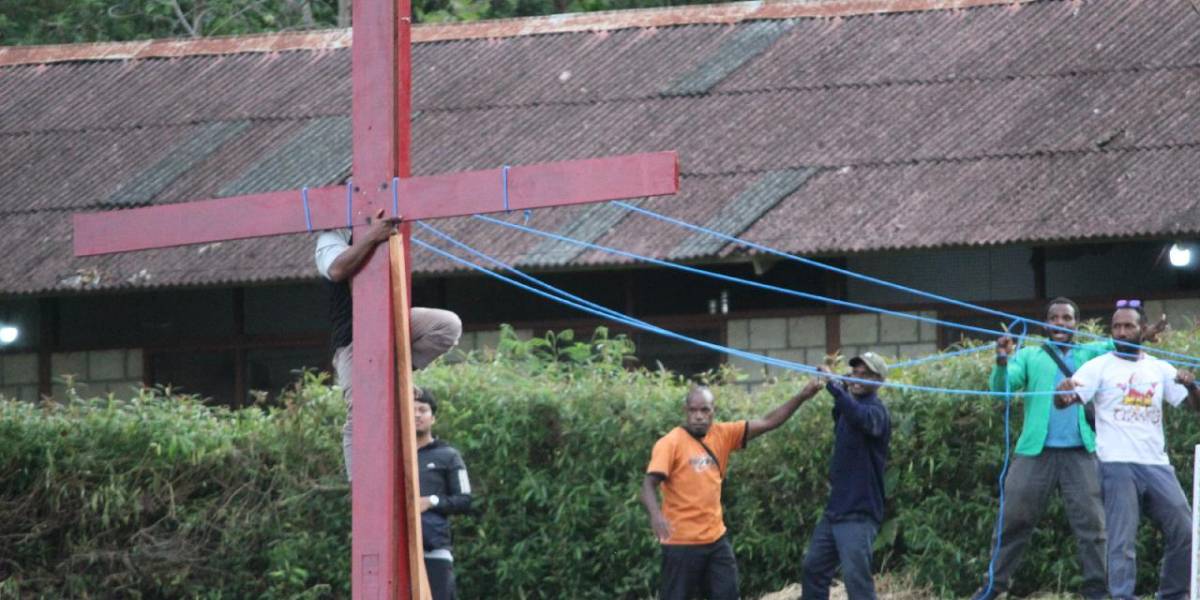
In the southern part of West Papua, Christian communities have erected 1,400 crosses to prevent the takeover of indigenous land. Painted red, these seven-meter-high crosses are strategically positioned in areas of land and forest that the Indonesian government and corporations have targeted for development.
The campaign aims to protect the areas in question. But the crosses also stand as “a symbol of resistance to militarized and corporate-driven deforestation and land dispossession,” according to CSI’s local partners.
Large-scale land acquisition
Franky Woro is one of the initiators of the campaign. Woro is a member of the Awyu, an indigenous Papuan group living in the rainforests of southern West Papua. Since 2021, the 27,300-strong Awyu, who are mainly Catholic, have been fighting against the encroachment onto their indigenous land by the Indonesian state and palm oil corporations.
In 2023, Woro filed a lawsuit against plans by a Malaysian palm oil company to clear tens of thousands of hectares of forest that the indigenous people claim is their ancestral land. The Indonesian Supreme Court rejected that appeal last November.
The Awyu are not the only indigenous group to experience large scale land grabbing and deforestation. Last year, Indonesia’s new president Prabowo Subianto launched a program targeting at least three million hectares of indigenous land and forest for a national strategic project on food and energy. Observers expect the program will bring millions of Indonesian settlers—mainly Muslims—to West Papua.
Church bodies have protested at the planned resettlement as well as the seizure and development of indigenous land, warning that land acquisitions are leading to the decimation of Papuan communities and the destruction of rainforests and biodiversity. On November 11, 2024, the Papuan Council of Churches and the Association of Native Catholic Priests published a statement supporting the Papuan peoples’ non-violent struggle to defend their land and forest.
1,400 crosses
The “red cross movement”, as it is known, unites the mainly Catholic southern Papuan communities affected by the national strategic project and deforestation. Together they have planted over 1,400 crosses so far.
And the campaign continues. To mark UN Human Rights Day in December last year, the Papuan Council of Churches and the Association of Native Catholic Priests came together to hold an event called “the Way of the Cross” in Jayapura, the Papuan capital.
At the event, participants erected their own seven-meter red-painted cross, in a gesture of solidarity with communities in the south.
“Jesus’ cross is a symbol of hope and power for us, for Papuan communities that continue to suffer today,” said one of the leaders of the Kingmi evangelical church that is part of the Council of Churches.
The campaigner Franky Woro was among those who participated in the Way of the Cross event. “We are grateful that some of the church leaders showed their solidarity,” Woro said. “Through this event, we are connected to our fellow Papuans from other tribal groups who are facing the same problem.”
Sixty years of struggle
CSI highlighted the dispossession of the indigenous people of West Papua in a statement to the United Nations Human Rights Council in March 2024.
The Netherlands handed West Papua over to Indonesia in 1962. This decision provoked widespread protests in West Papua, and an independence movement that continues until today.
West Papua is rich in natural resources, boasting large gold and copper deposits and tropical forests. To secure control over these resources, successive Indonesian governments have subjected the region to military occupation. This is still ongoing, and military operations have led to tens of thousands of West Papuans being displaced. Furthermore, Indonesia has resettled hundreds of thousands of non-Papuans in the area in a bid to subjugate it.

Indigenous people in West Papua take part in an outdoor worship service