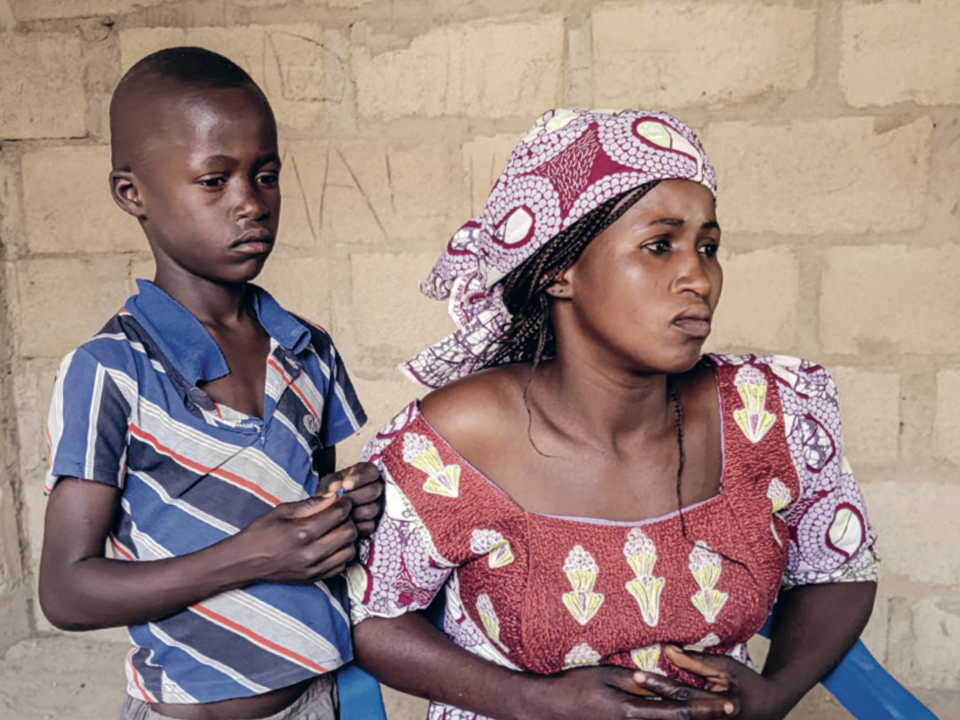
Islamist HTS leaders have been promoting a narrative of tolerance for minorities in Syria since taking control of Aleppo. While Christians, Druzes, and Alawites have been safe so far, the ideology and history of HTS caution that deadly risks likely lie behind the diplomatic rhetoric.
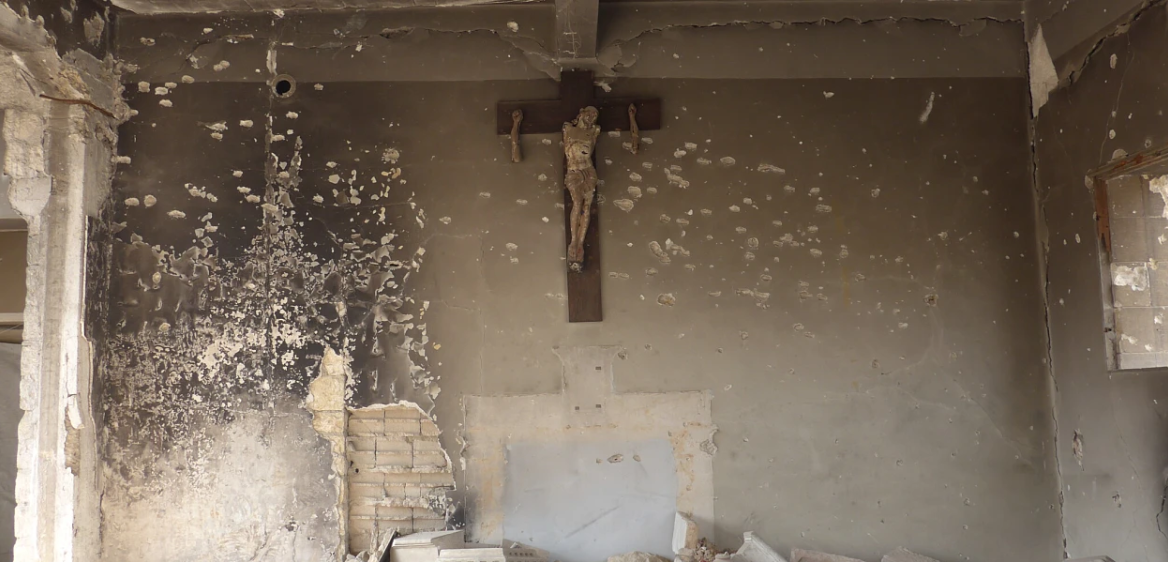
A crucifix hangs on the wall of a church in Aleppo desecrated by “moderate” rebels. csi archive photo from 2017
Since regaining control of the city of Aleppo last week for the first time in eight years, the Sunni Islamist group Hay’at Tahrir al-Sham (HTS) has been broadcasting a message of tolerance. According to the jihadists, Christians and other religious minorities like the Druzes and Alawites have no need to fear.
The Political Affairs Department of HTS’ Syrian Salvation Government, has issued a number of statements to this effect, assuring civilians that they will “remain shielded from any targeting or threats based on sectarian or ethnic affiliation.” CSI’s contacts in Aleppo confirm that, so far, Christians and religious minorities have been treated well by HTS and its allies.
Still, HTS’ ideology and history give religious minorities in Aleppo serious reason to doubt these promises. HTS and its predecessors have been fighting in Syria for 13 years; in Syria’s Idlib province, they have been in power since 2015.
What does HTS’ record show about what religious minorities can expect?
Three key minority groups in Syria
The Alawites, Druzes, and Christians comprise the three primary religious minorities under threat in Syria.
Both Alawites and Druzes are Muslim minority sects that the jihadists consider heretical. Both groups have also relied on the Syrian government for protection from jihadist attacks, and the Alawites historically supported Syrian President Bashar al-Assad, also an Alawite, thus adding to the political tension with HTS.
Christians are not seen as heretics but rather a subjugated and protected class in HTS ideology. In practice, however, HTS has often targeted Christians throughout Syria in violent attacks and kidnappings, repeatedly killing Christian civilians and confiscating their property. Since 2012, the vast majority of Christians who lived in Aleppo or Idlib during the periods under the jihadists’ authority have fled.
Alawites
The Alawites, a minority Muslim sect regarded as heretical by many Sunni Muslim authorities, account for around 10% of Syria’s population. They were historically marginalized in the Ottoman Empire and the independent state of Syria, until a trio of Alawite military officers seized power in Syria in 1963. One of the trio, Colonel Hafez al-Assad, would go on to rule Syria from 1970 to 2000.
Hafez al-Assad, the current president’s father, linked the Alawite faith to the more mainstream Shi’ite Islam, and his government normalized visible expressions of Shi’ism in Syria, an association seen as key to Iran’s support of the Syrian regime. Alawites have largely supported the Syrian government during the current civil war, fearful that a rebel victory could lead to revenge by the majority Sunni population that would destroy their community.
On December 4, HTS issued a statement to the Alawite community, asking them to “become part of the Syria of the future,” but demanding that they “detach themselves from this regime and join the true cause, to correct the mistakes of the past.”
But in the past, HTS’ leaders took a very different tone. Abu Mohammad al-Jolani, the leader of HTS and its predecessor organization, Jabhat al-Nusra, said in 2015 that Alawites could only receive “mercy” if they “renounced” their religion and converted to Islam. In 2016, Nusra’s top religious official declared of Alawites, “The land must be purged of them.”
Throughout the civil war, jihadist groups like al-Nusra have singled out Alawites for violence. In 2013, rebel forces led by Jabhat al-Nusra massacred and kidnapped hundreds of Alawite civilians in the Latakia region.
In light of this history of violence and threats, HTS’s new assurances of safety are uncomfortably vague.
Druzes
The Druzes, or Muwahhidun as they call themselves, are another minority Muslim sect, accounting for perhaps of 5% of Syria’s population.
Like the Alawites, jihadists consider Druzes as heretics worthy of death. Ibn Taymiyya, a 14th century Islamic scholar revered by modern jihadists, declared the Druze “apostate heretics” whose “repentance is not accepted.” Druze men must be killed; the women, enslaved.
Unsurprisingly, the Druze have often relied on the Syrian government for protection during the civil war. In 2014, the al-Nusra Front (now HTS) abducted, tortured, and sentenced to death some Druze fighters who attempted to support the rebel Free Syrian Army forces. Though FSA mediators helped to secure their release, the incident made clear that the rebel movement would not accommodate the Druze.
Unlike the Alawites, large numbers of Druzes lived in Idlib province before HTS’s takeover. According to one source, only 12,000 Druze live in Idlib province today, down from 30,000 before the war. HTS has forced those who remained to officially convert to Sunni Islam. Even then, they have not been completely safe – 20 Druze were massacred by Nusra fighters in June 2015, and many Druze families have had their land confiscated.
In recent years, as HTS has tried to cultivate a more moderate image, al-Jolani has repeatedly visited Druze villages, and promised to protect the Druze and restore their property. But the Druze are still vulnerable to harassment and abuse by jihadist fighters in Idlib, and HTS has not removed the requirement that the Druzes convert to Sunni Islam.
Christians
Before Syria’s civil war began, Aleppo was one of Syria’s most Christian cities. Out of a prewar population of around 2 million, around 200,000 were Christians.
Today, only about 20,000 Christians live in Aleppo. Many of those who left fled in the years 2012-2016, when al-Nusra and other jihadist groups occupied eastern Aleppo, driving Christians out of their homes and bombarding Christian neighborhoods in western Aleppo with rocket attacks. Only after the government reconquered eastern Aleppo in 2016 were Christians able to live in the city in safety.
HTS and its allies have also attacked Christians in other places in Syria. Throughout the civil war, Christians have been targeted with kidnappings, car bomb attacks on churches and Christian neighborhoods, and even worse violence. In September 2013, al-Nusra fighters overran the Christian holy city of Ma’alua in the mountains north of Damascus, kidnapping nuns and driving out the Christian population. When al-Nusra fighters and their allies occupied the Christian town of Sadad in October 2013, they killed at least 41 Christian civilians and used others as human shields.
Unsurprisingly, when al-Nusra and its allies conquered Idlib province in 2015, nearly the entire Christian population of 10,000 fled. Others were killed or kidnapped, and their property confiscated. Only 300 Christians remain in Idlib today.
But since 2015, church leaders in the province have established a working relationship with HTS and its leaders. In recent years, al-Jolani has begun to regularly visit Christian villages in Idlib to reassure them. The Christians who have remained in Idlib have received some, but not all, of their confiscated property back.
In the Salafist worldview that animates HTS, Christians are not heretics to be destroyed (like the Alawites and the Druzes), but “people of the Book” – followers of religions that were revealed before the coming of the prophet Muhammad. In lands ruled by Islam, they should be made dhimmis – a protected people who are kept in legal subjugation and pay an additional tax called the jizya.
Until now, HTS has avoided imposing dhimmi status on Christians in Idlib by referring to them as musta’min, or temporary residents. But how long will HTS maintain this distinction?
A key test is now approaching: HTS forces are bearing down on the Greek Orthodox town of Muharda. Throughout the war, the residents of Muharda have resisted rebel attacks on their town.
On December 5, al-Jolani issued a message to the residents of Muharda, telling them that, “we have treated the sons of the Christian religion well in Idlib and Aleppo, and in the same way we will protect you and your property.”
Given the history of Syria’s civil war – and the reality of what Christians in Idlib and Aleppo experienced at HTS’ hands – this promise is unlikely to be believed. And a violent encounter between HTS and Muharda’s Christian defenders could clear the way for more attacks on Christians, rooted in jihadist ideology.
An Uncertain Future for Religious Minorities under HTS
In 2018, the Syria scholar Fabrice Balanche observed, “In areas held by the rebels, ethnic homogeneity is de rigueur, and native Christians, Druze, and Shia have been forced to leave or convert.”
That largely held true until November 2024. But with this new offensive, the jihadists of HTS have conquered a large swathe of territory home to tens of thousands of religious minorities. They are poised to advance farther, into lands home to numerous Alawites, Christians, and other religious minorities.
In Aleppo today, an uneasy calm reigns. Even in the reprieve from the bombing, as people who had been sheltering indoors begin to emerge from hiding, our contacts in Aleppo report that they are living with uncertainty day to day, hour to hour, in great need of prayer.