On May 26, a cross-party Swiss parliamentary committee launched the Swiss Peace Initiative for Nagorno Karabakh in the Swiss capital, Bern.
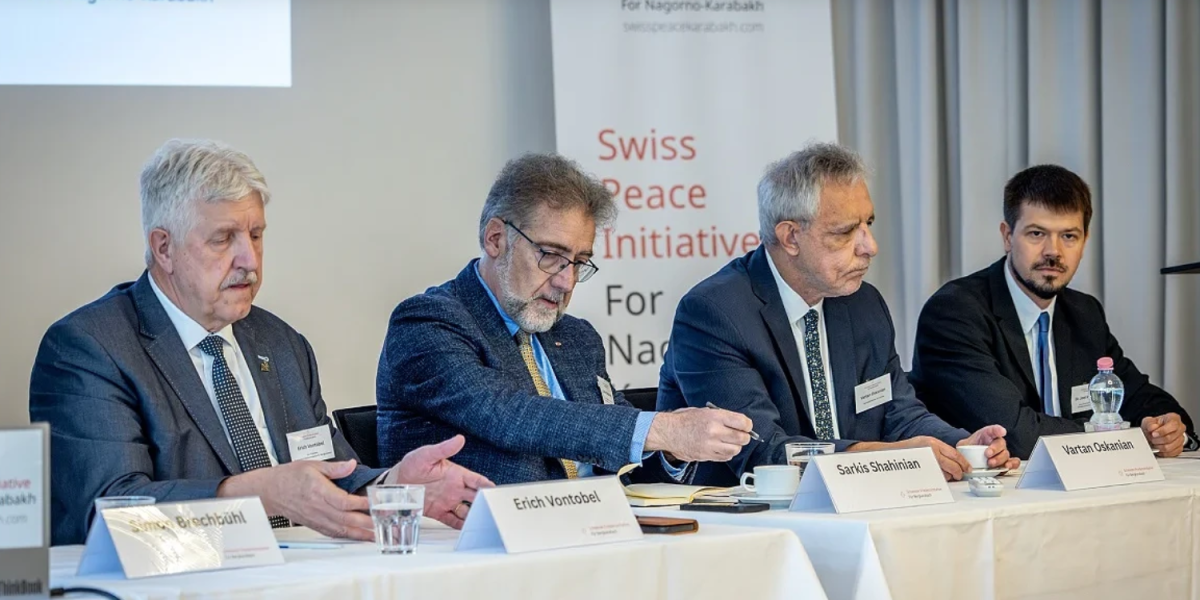
Speakers at the launch of the Swiss Peace Initiative in Bern, left to right: Erich Vontobel, Sarkis Shahinian, Vartan Oskanian, Joel Veldkamp. csi
– Switzerland urged to move ahead quickly with peace forum
On May 26, a cross-party Swiss parliamentary committee launched the Swiss Peace Initiative for Nagorno Karabakh in the Swiss capital, Bern. The committee comprises 19 Swiss parliamentarians from across the political spectrum who are united in their desire “to support a sustainable political solution to the conflict between Azerbaijan and the displaced Armenian population of Nagorno Karabakh.”
The launch event featured presentations from the committee co-chairs, National Councilor Erich Vontobel (EDU, Zurich) and National Councilor Stefan Müller-Altermatt (The Center Party, Solothurn). Other speakers included National Councilor Carlo Sommaruga (Social Democratic Party, Geneva), Vartan Oskanian, the former foreign minister of Armenia and current Chairman of the Committee for the Defense of the Fundamental Rights of the People of Nagorno Karabakh, Vardan Tadevosyan, the Director of the Lady Cox Rehabilitation Centre (formerly in Nagorno Karabakh), Sarkis Shahinian, the General Secretary of the Parliamentary Friendship Group Switzerland-Armenia, and Dr. Joel Veldkamp, Director for Public Advocacy for Christian Solidarity International.
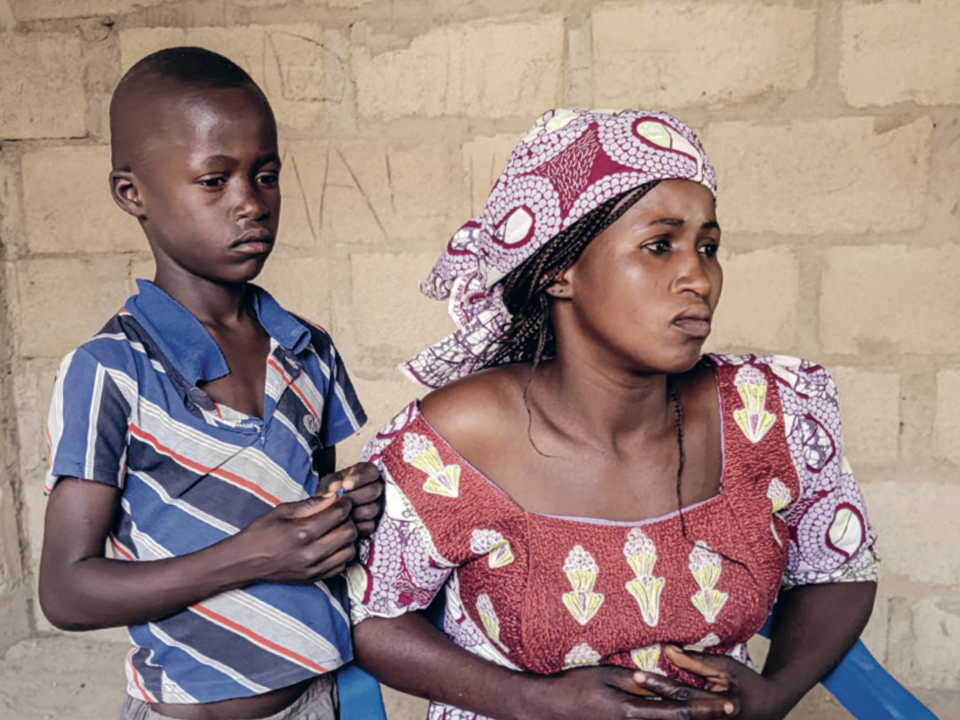
Nagorno Karabakh’s population of 120,000 Armenian Christians was forced to flee in the wake of Azerbaijan’s invasion in September 2023. The exodus came after a decades-long struggle over the territory, historically inhabited by Armenians, but claimed by Azerbaijan.
Following approval by both houses of parliament, Switzerland has now committed to hosting a peace forum to negotiate the safe return of expelled Armenians to their homeland of Nagorno Karabakh (or Artsakh). The stated aim is to “facilitate an open dialogue between Azerbaijan and representatives of the Nagorno-Karabakh Armenian people,” to negotiate the safe and collective return of the Armenian population.
The launch of the committee is an important step towards realizing this declared commitment, said co-chair Stefan Müller-Altermatt. He underlined the “extremely important” role of Switzerland in upholding the human rights of the Karabakh Armenians who, as a result of the invasion and during the nine-month blockade that preceded it, had been “starved, threatened and deported” by Azerbaijan.
His parliamentary colleague Erich Vontobel recalled a visit he paid to Armenia in 2024 when he met with refugees from Nagorno Karabakh. “They asked me, please do something, so we can go back,” said Vontobel. “I promised to help and a week after returning home I brought the motion in parliament for a peace forum.” But Vontobel stressed that the work had just begun with the passing of the motion. “We can’t afford to sit still; the peace forum still has to be organized,” he said.
The plight of the deportees – especially those with a disability – was also highlighted by Vardan Tadevosyan, the health minister of Nagorno Karabakh. Tadevosyan is the founder and director of the only rehabilitation center in Stepanakert, the capital of Nagorno Karabakh, which served people with disabilities from all over Karabakh before the invasion. He referred to the “massive stress” suffered by the patients when they were forced to leave for Armenia. “I thought one day after our arrival that, if it is so difficult for me, what about the people who we served for 25 years,” he said. “Coming to Armenia, they were in a completely new situation. They had no place to live, they had no houses adapted to their situation.” Tadevosyan urged the Swiss parliamentarians to do everything in their power to make the peace forum, and the return to Karabakh, a reality.
Vartan Oskanian, a former foreign minister of Armenia, also stressed the human dimension of the conflict. “People just want to go back to their homes,” he said. “Don’t look at this as a political demand. It’s a human demand and it needs to be addressed.” Oskanian pointed out that the International Court of Justice has ordered that the displaced Armenians be allowed to return, and that the European Parliament has passed two resolutions calling for their right of return to be upheld.
While an international consensus is forming that the displaced Armenians should be allowed to return, the question arises of how, when, and under what conditions. “The task is to ensure that any future return is consistent with international human rights law,” he said. The proposed forum would provide the framework for that to happen. For Oskanian, Switzerland, with its long humanitarian tradition, is uniquely placed to host a peace forum.
National Councilor Carlo Sommaruga pointed out that Switzerland will assume the presidency of the OSCE in 2026, which “underlines the fundamental role that Bern can play in the constitution of a peace forum for Nagorno Karabakh.” Sarkis Shahinian urged Switzerland to support the activation of the OSCE’s “Moscow Mechanism,” which would subject Azerbaijan to an international fact-finding mission over the ethnic cleansing of Nagorno Karabakh and its illegal detention and trials of 23 Armenians, including members of the former political and military leadership of Nagorno Karabakh.
Joel Veldkamp of CSI noted that the international community has been unable or unwilling to respond effectively to the escalation of violence in Nagorno Karabakh. But there were signs of “a new appetite for peace and cooperation.” “All the great powers – the United States, the European Union, the United Kingdom and Russia – have an interest in avoiding a new war in the Caucasus, and establishing a durable peace,” he said.
“By giving their backing to the Nagorno Karabakh Peace Forum that the Swiss Federal Council will hold in the coming months, these powers can reset the dangerously moribund peace process in the Caucasus and place the region on a path towards true peace, a peace based on justice,” he concluded.
Full videos of the event will be available on the website of the Swiss Peace Initiative, www.swisspeacekarabakh.com.