In 2024, India recorded an average of more than two attacks on its Christian minority each day, totaling 834 documented incidents—the highest in the nation’s history, as reported by the local group United Christian Forum (UCF). The incidents represent a more than 555% increase over the decade from 2014 to 2024.
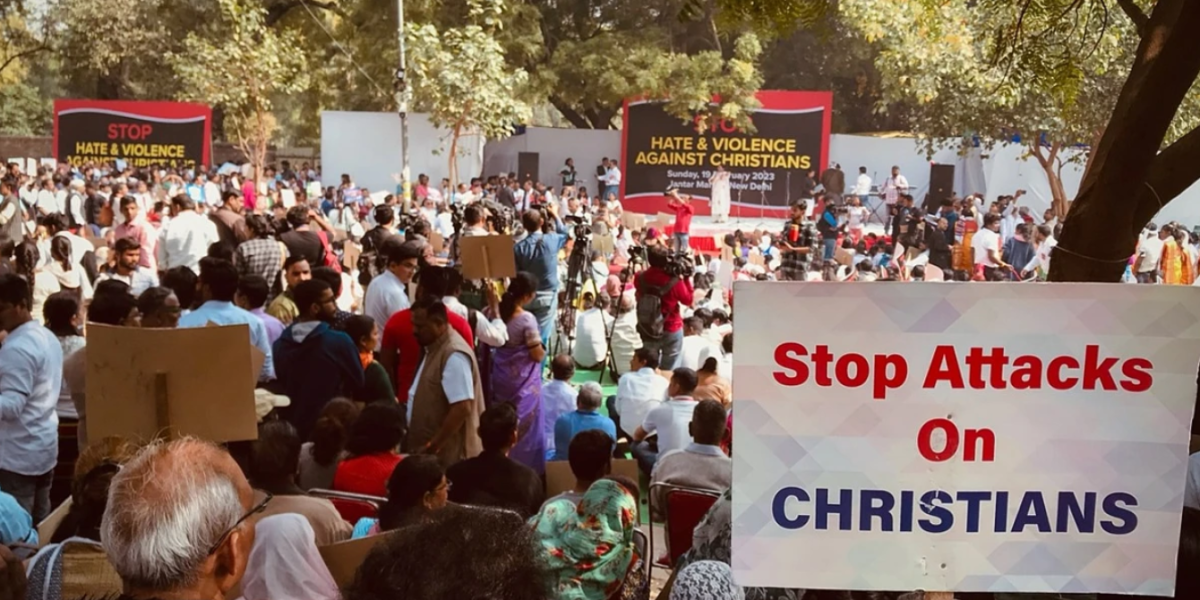
Christians at a 2023 protest in Delhi against rising attacks on the minority community. CSI archive
In a statement released on January 24, 2025, the UCF said it recorded 834 verified acts of violence and intimidation against Christians in India in 2024. This number rose from 127 incidents in 2014.
Attacks on Christians
The UCF data reveals a troubling spectrum of abuses.
The 834 incidents include 149 physical assaults, 209 property damage incidents and 798 cases of intimidation, threats or harassment. Some incidents involved a combination of physical assaults, property damage and/or intimidation.
According to UCF, there were 331 instances where Christians faced restrictions on religious gatherings, despite India’s constitutional guarantee of religious freedom, including worship.
Hindu nationalist groups often obstruct these gatherings, claiming “forcible” conversions of Hindus. Frequently, local officials influenced by these groups unlawfully demand that Christians obtain permission to hold worship services, even in private homes.
Hotbed of Christian persecution
The Hindu nationalist Bharatiya Janata Party (BJP) governs the northern state of Uttar Pradesh and Chhattisgarh state in eastern India, states where Christian persecution is most severe, according to the UCF data. In 2024, these states recorded 209 and 165 attacks respectively.
For example, on April 26, 2024, in Chhattisgarh, a 65-year-old Christian man died in a hospital. His grieving family faced further distress when local religious extremists blocked them from burying him in the village and demanded their “reconversion” to Hinduism. The body remained at the hospital because local police would not release it without a “No Objection Certificate” from the village council, even though this was not legally required. The funeral took place two days later with the help of CSI’s local partner, which offered legal assistance. The family conducted the burial according to Christian customs under the protection of about 500 police officers, ensuring peace in the village.
The group suggested that the actual number of attacks could be between three and ten times higher, as many incidents likely go unreported due to fear of reprisals in what is described as a climate of impunity. “Across the country, the crimes that come to our notice maybe from trice to ten times at the grassroots,” UCF stated.
Police inaction
The group added that out of the 834 reported incidents, only 392 were registered as “First Information Reports” (FIRs), the term for formal police reports in India. UCF noted that investigating officers determine which complaints are escalated to FIRs, a process that often results in some cases remaining unexamined.
UCF described the statistics on attacks on Christians as “disturbing,” warning that the future of the Christian community could be at risk if authorities do not take action.
“Fear dominates the discourse – fear of the cultural ‘police’ which define who is an Indian, who is a loyal citizen, and who is an alien, to be identified, isolated, and eliminated,” the group said. “There is fear of the establishment borne out of the experience of the past decade where the guilty go free and innocent pastors, their wives and on occasions their children, have been pushed into jails.”
‘Anti-conversion’ laws
Currently, at least 100 Christians are in jail on accusations of “forcible” conversion, “with bail repeatedly denied,” according to UCF. “The justice process has become the punishment.”
Several Indian states have enacted “anti-conversion” laws, stipulating that no one shall convert another person to a different religion from their ancestors’ by force, fraud or allurement. Some of these laws mandate that individuals obtain permission from local authorities before converting to another religion. Hindu nationalist groups routinely file police complaints against Christians under these laws, with police often registering these complaints swiftly, even without prima facie evidence and leading to prompt arrests.
Although Christians make up 2.3 percent of India’s population, compared to Hindus who constitute nearly 80 percent, attacks on Christians frequently occur under the guise of preventing “forcible” conversions of Hindus to Christianity, fueled by Hindu nationalist propaganda. Extreme Hindu nationalists not only perpetrate or incite violence but also often force Christians or Christian victims to “reconvert” to Hinduism.
‘Living in fear’
“The Christian community, which has long been a peaceful and integral part of India’s diverse society, is now living in fear,” said Dr. Michael Williams, President of UCF. “Attacks against the community have become more frequent, brutal, and systematic. These are not just numbers; they are the stories of real people, families torn apart, communities destroyed, and lives shattered as a result of their faith.”
Williams said the worst period of 2024 arrived around Christmas, when the group recorded 14 attacks on Christian gatherings in different parts of the country.
UCF’s data also points to the effects of these incidents on specific vulnerable populations. The victims of Christian persecution included 154 women, 342 “Dalits” (officially called Scheduled Castes) and 354 “indigenous” persons (officially called Scheduled Tribes). Dalits are members of the lowest caste in India, who historically suffered discrimination and marginalization in various aspects of social, economic and political life. The majority of Christians in India come from Dalit backgrounds. An indigenous person is a member of a group that originally inhabited a region and maintains unique cultural, social and historical ties to the land, often distinct from dominant national cultures.
UCF explained that Christians from vulnerable backgrounds often lose access to community resources or face public shaming when they are targeted for their faith.